Cell Towers

Find the Dead Zones Before You Break Ground

BigGeo's Cell Towers dataset delivers tower coordinates, carrier identifiers, radio technologies, and estimated coverage ranges for 100,000 sites, ready for immediate spatial analysis. For the first time, your team can identify underserved coverage areas, prioritize deployment targets, and validate site acquisition decisions without a single field survey.

At a Glance

The Data Behind the Decision

100,000
Tower records ready to query
Multi-carrier
Carrier identifiers included
Multi-technology
Radio technologies covered
Buy by Geography

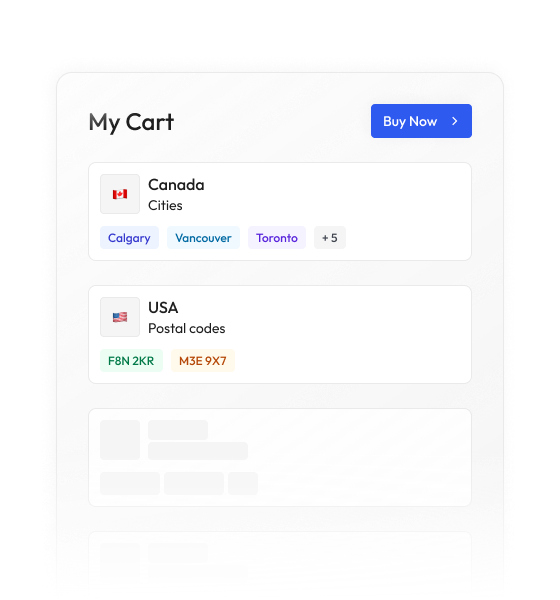
Stop buying the whole country. Buy just your markets.

Most data vendors sell you a national license to millions of records you will never contact. BigGeo works differently.You tell us where you sell, and we cut you exactly that geographic slice of the dataset. A single city.

A cluster of ZIP codes. A metro area. A county. Whatever matches your territory. The result is a lean, CRM-ready file containing only the companies in the markets you actually work, delivered at a fraction of the cost of a full national license.
Book a Meeting

See a Live Coverage Gap Analysis

The Problem

Coverage Planning Is Broken Without Good Data

Wireless infrastructure teams are making six-figure deployment decisions on data that is incomplete, outdated, or locked inside formats no one can query at speed. Field surveys eat weeks of budget. Coverage models built on bad tower data produce bad tower placement. And every week a dead zone stays unaddressed is a week a competitor or a federal broadband program fills it instead.

radar
Dead Zones You Cannot See
Without a complete, queryable picture of existing tower locations and coverage ranges, gap analysis is guesswork. Teams default to field verification that costs more and confirms less than a proper data-driven baseline.
pin_drop
Site Selection Built on Assumptions
RF engineers and site acquisition teams spend weeks triangulating tower placement options from fragmented sources. A single wrong assumption about an existing site's coverage radius ripples into a misplaced tower and a wasted capital budget.
layers
Carrier Overlap Nobody Mapped
Understanding which carriers already serve a corridor, and which radio technologies they run, is foundational to any competitive or public-sector broadband expansion strategy. Most teams are flying blind on this until they are already in the field.
track_changes
Slow RF Workflows Killing Deadlines
Grant applications, municipal contracts, and private LTE timelines do not wait for slow data pulls. When the underlying tower dataset is not pre-indexed for spatial compute, every query becomes a project of its own.
What Is In The Dataset

Everything Your RF Team Needs to Move Faster

Precise Tower Coordinates

Every record includes geospatially indexed tower locations, so your team can instantly map existing infrastructure, calculate inter-site distances, and identify placement candidates without converting or cleaning raw coordinates.

Carrier Identity Per Site

Carrier identifiers attached to each tower let you analyze competitive coverage density by operator, identify underserved corridors no single carrier has claimed, and build a defensible rationale for new market entry or expansion.

Radio Technology Classification

Knowing whether a site runs LTE, 5G NR, CBRS, or legacy technologies tells your engineering team what gaps to fill, not just where. Technology-aware gap analysis changes how you prioritize small-cell versus macro tower deployment.

Estimated Coverage Ranges

Coverage range estimates per tower let you model actual signal footprints, overlay them against population or address density, and surface the specific geographies where investment will have the highest coverage yield per dollar spent.

Let's talk
Thank you! Your submission has been received!
Oops! Something went wrong while submitting the form.
done
The world's spatial data is more accessible than you think. Let's show you how close you already are.
done
You already have the questions. We have the data. Let's see what happens when they meet.
done
The where in your business is more important than you think. Let's find it together.
done
Most spatial data conversations start with a problem nobody thought was solvable. What is yours?
BigGeo AI

Ask Coverage Questions in Plain Language, Get Governed Spatial Answers

BigGeo AI is live in ChatGPT today and shipping in Claude, giving your engineers and GIS analysts direct access to the Cell Towers dataset through plain language queries, no GIS software required, no data pull, no waiting on a specialist. A site acquisition manager can ask which counties in a target state have fewer than three LTE towers per 100 square miles and get a governed, data-grounded answer in seconds. The underlying tower data never leaves the governed compute path regardless of how the query is routed.

chat
Which counties in our target state have the lowest LTE tower density relative to population?
chat
Show me all towers within 15 miles of our proposed small-cell deployment corridor and their carrier IDs.
chat
Identify census tracts with no tower coverage within 10 miles for our BEAD grant application.
FAQ

Frequently asked questions

How current is the tower data, and how do I know it reflects actual field conditions?
add
We already have some tower data internally. Can we combine it with this dataset?
add
Does the dataset cover rural areas where coverage gaps are most critical for broadband grants?
add
How do we access the data technically? Do we need a GIS team to use it?
add
How do we get started, and what does the sample request process look like?
add